the patient
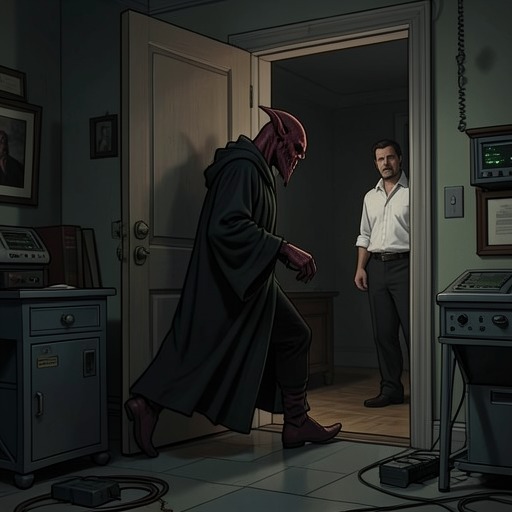
The Screwtape LettersThe patient is the human life at the center of Screwtape’s correspondence, and his decisive significance lies in the outcome the demons cannot prevent: after conversion, temptation, renewed faith, love, and wartime service, he dies in an air raid and enters Heaven. Because his story is presented through the letters of demons who are trying to manipulate him, the account discloses his progress indirectly—and makes their frustrated, self-serving interpretations part of the evidence about what they misunderstand.
Identity and Introduction
The patient begins as a man whose reading and habits are under Wormwood’s attention. Screwtape argues that direct reasoning is a poor way to draw him away from faith: he has grown accustomed to treating ideas as “academic” or “practical,” “outworn” or “contemporary,” rather than primarily as true or false. The demonic advice is therefore to associate materialism with strength, courage, or the future, using fashionable labels in place of argument. The patient’s vulnerability, as Screwtape describes it, lies not in a demonstrated intellectual position but in the habits through which he is taught to assess one.
The opening account also places limits on what can be known about him from the letters. The preface warns that the devil is a liar and that Screwtape’s claims should not automatically be trusted, even by the standards of his own perspective. The patient’s conduct is filtered through an adversarial correspondent who wants to direct it and whose reports serve his own purposes. His story must therefore be read both as a record of spiritual danger and as an account shaped by infernal misapprehension.
Conversion and Everyday Temptation
Screwtape reacts with grave displeasure when Wormwood’s patient becomes a Christian, but treats the conversion as a setback rather than an irrevocable conclusion. He points to the patient’s established mental and bodily habits as openings through which he might be reclaimed. Even the patient’s new participation in church can be turned against him: Screwtape urges Wormwood to make him focus on the building, its books, and the appearance or behavior of the people in the neighboring pews, so that ordinary imperfections will seem to discredit religious belief. The strategy works by distracting him from the Church as a spiritual reality and directing him instead toward details he might find awkward or ridiculous.
The patient’s relationship with his mother offers another field of attack. Screwtape tells Wormwood to coordinate with Glubose, who is assigned to her, and cultivate a household pattern of mutual annoyance through daily irritations. He recommends keeping the patient absorbed in inward states and advanced spiritual concerns, so that he neglects obvious duties that people who live or work with him would readily notice. The same distortion can enter prayer: attention to the mother’s soul is to be detached from care for her physical discomfort, while her irritating actions are recast as sins. In this plan, spiritual self-examination and prayer become means of avoiding the concrete responsibilities of shared life.
Repentance and Renewal
Later, Screwtape recognizes that Wormwood has allowed the patient to slip away. The patient has undergone repentance and a renewal that Screwtape calls a defeat of the first order, amounting to a second conversion and probably a deeper one than the first. The shift is described from the tempter’s side: what matters is not that the patient has ceased to face temptation, but that he has returned to a spiritual allegiance the demons had hoped to weaken.
Screwtape identifies two ordinary pleasures associated with this renewal. The patient reads a book for the enjoyment it gives him, rather than to perform cleverness for his new friends, and walks alone through country he likes to the old mill, where he has tea. Screwtape calls these real pleasures and fears their contact with reality: they interrupt a demonic preference for imagined distress and self-absorption. The scene links the patient’s inward change to simple activities undertaken for their own sake, not to display or social advantage.
Love, War, and Conduct
As the war draws nearer, the patient falls in love with a very Christian woman. Screwtape says this temporarily makes him less susceptible to attacks on his chastity, while also complicating the demons’ broader campaign against his spiritual life. He is increasingly occupied with defence work and with the woman he loves; he must attend to his neighbors more than before, and, to Screwtape’s alarm, finds that he likes doing so. He is also described as growing in conscious dependence on God. These developments bring his attention outward—to work, love, and other people—rather than leaving him enclosed in the private preoccupations that the demons sought to foster.
The prospect of an air raid makes the patient’s continued life a strategic concern for Hell. Wormwood has welcomed the likelihood of heavy bombing, but Screwtape rebukes him: if the patient dies at this point, the demons lose him. The patient has escaped the worldly friends with whom Wormwood tried to entangle him, is in love, is occupied with defence work, and is becoming more attentive to his neighbors. Screwtape fears that death would end their opportunity to exploit the long years of ordinary prosperity or adversity, when routine and the gradual wearing down of youthful hopes might again expose him to temptation. His insistence that Wormwood protect the patient’s bodily safety reveals an infernal calculation at odds with the human tendency to treat death as the greatest evil.
During the first raid, the patient is frightened and thinks himself a coward, so he takes no pride in his conduct. Yet he does everything his duty requires and perhaps more. Screwtape’s report acknowledges only minor failings—a burst of ill temper with a dog that trips him, excessive cigarette smoking, and a forgotten prayer—and treats the patient’s dutiful action as a far more serious defeat. The contrast is central to his wartime conduct: fear and self-criticism remain, but they do not prevent him from doing what duty demands.
Death, Recognition, and Ending
The patient dies in the bombing and enters Heaven, a loss that provokes Screwtape’s final, furious letter to Wormwood. In the moment of death, Screwtape imagines that the patient’s sight clears: he recognizes the tempter’s part in his life and sees the spiritual company that had been present when he supposed himself alone. What had been an indistinct sense of friendship and a musical quality in pure experience becomes intelligible to him. Recognition gives him entrance into their company, while Wormwood is left outside.
The patient also sees God. Screwtape contrasts his own response to the divine presence with the patient’s: what is suffocating and blinding to the demon is, for the patient, clarity and cool light in the form of a Man. The patient’s awareness of his sins and his prostration before God do not, in Screwtape’s account, amount to the demonic experience of paralysis. The passage instead emphasizes a new relation to pain and pleasure: the patient can accept pain without trading away the reality he has found, and former attractions lose their power by comparison with the beloved presence before him.
Screwtape’s last account makes the patient’s death an abrupt reversal of the demons’ expectations. The sounds and hardships of the bombing give way, for the patient, to a new life in which earlier terrors no longer govern him. Screwtape’s imagery of cleansing and liberation expresses the defeat in terms he can barely endure, while his anger at Wormwood turns the lost soul into a source of infernal rivalry. The patient’s arrival in Heaven is therefore both the completion of his spiritual trajectory and a demonstration of what Hell cannot explain: the love and freedom it dismisses as impossible, and the recognition that makes its own claims on him fall away.
Narrative Role and Significance
The patient is not given a direct voice across most of the letters; his life is reconstructed from Screwtape’s instructions, Wormwood’s reported failures, and Screwtape’s changing assessment of the campaign. This epistolary distance lets the reader see how the demons attempt to redirect attention—from truth to fashionable language, from duty to self-scrutiny, from a mother’s real discomfort to imagined spiritual deficiencies, and from love and neighborliness to self-interest. The patient’s progress is registered in the failure of those strategies as much as in any direct account of his thoughts.
His ending also reverses the demons’ use of ordinary human categories. They treat survival as a means of prolonging temptation, and death as an event that might frustrate their plan; the patient’s actual death instead removes him from their reach. His fear during the raid does not negate his duty, and his recognition in Heaven transforms the uncertainty that had surrounded spiritual companionship into knowledge. Through this contrast, the patient’s story gives concrete form to the book’s conflict between infernal possession and a life grounded in dependence, love, service, and ultimate freedom.